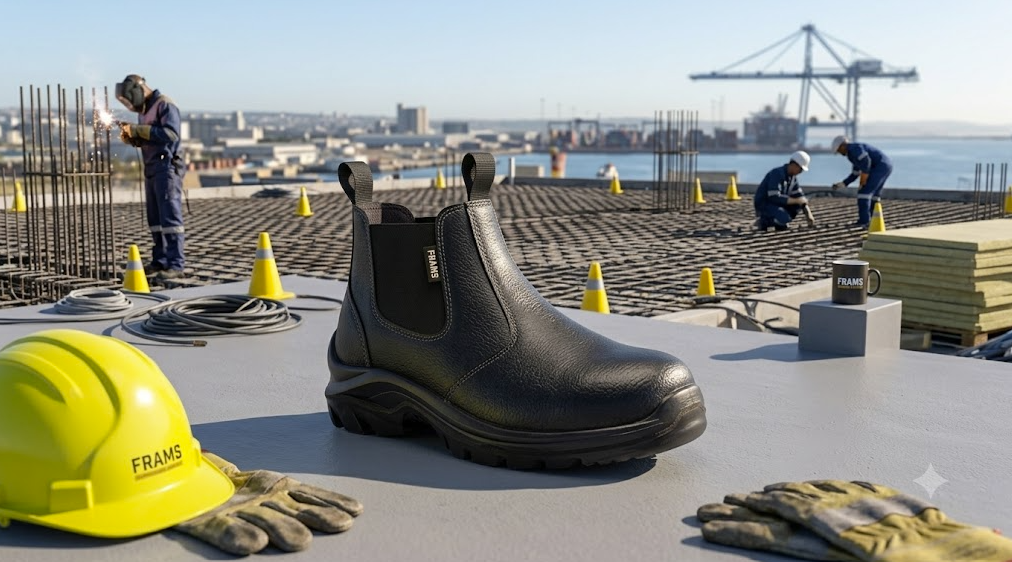
When outfitting workers for a busy industrial facility, selecting between safety shoes and safety boots is a key decision that impacts worker comfort, mobility, and overall site safety.
While both styles offer essential hard-toe protection and slip resistance, choosing the right footwear format depends on the specific physical demands of the job. At Frams Footwear, our range offers both low-cut safety shoes and ankle-high safety boots built to deliver certified SANS/ISO 20345 protection at competitive price points.
Comparing Safety Shoes and Safety Boots
Feature | Frams Safety Shoes (e.g., Ndlovu Pumba, Chelsea) | Frams Safety Boots (e.g., Econo-Tuff, Ndlovu Addo) |
Ankle Coverage | Low-cut (below the ankle bone) | Mid-to-high cut (covers and supports ankle) |
Mobility & Flexibility | High agility; easier bending and kneeling | Firm stability; supports ankles on uneven terrain |
Weight | Lighter on the foot during indoor shifts | Heavier construction for maximum protection |
Best Workplaces | Warehouses, workshops, factories, drivers | Construction sites, outdoor yards, heavy industry |
Ease of Use | Quick slip-on (Chelsea) or lace-up options | Secure lace-up support for rugged environments |
When to Choose Frams Safety Shoes
Safety shoes like the Frams Ndlovu Pumba or the Frams Chelsea are designed for active workers who need maximum ankle mobility and low-weight comfort throughout their shift:
- Indoor & Smooth Surfaces: Factory floors, distribution centers, assembly lines, and retail yards where workers remain on flat surfaces.
- Frequent Bending & Kneeling: Stock handlers, technicians, and mechanics benefit from low-cut collars that do not press against the Achilles tendon during repeated movement.
- Rapid On/Off Access: The Frams Chelsea safety boot/shoe features elastic side gussets, allowing workers to slip their footwear on and off quickly while maintaining full steel toe protection.
When to Choose Frams Safety Boots
Ankle-high safety boots such as the Frams Econo-Tuff 2.0 or Frams Ndlovu Addo are essential whenever physical site hazards call for structural joint support:
- Uneven & Outdoor Terrain: Construction sites, agricultural fields, and quarry yards where loose gravel or rubble poses an ankle-twist hazard.
- Debris & Splash Protection: Higher leather collars prevent flying sparks, metal filings, dirt, and chemical splashes from entering the top of the boot.
- Heavy Construction & Mining: Outdoor sites requiring thick dual-density soles and reinforced upper stitching for demanding conditions.
Economical Durability Across the Whole Range
Whether you select safety shoes or ankle-high safety boots, every Frams product features:
- Direct-Injection PU Soles: Soles molded directly onto genuine leather uppers, eliminating glue failures and preventing sole separation.
- 200-Joules Steel Toe Caps: Certified impact resistance to protect against falling tools, crates, or heavy equipment.
- Oil & Acid Resistance: Specialized outsole compounds that resist swelling or degradation when exposed to common oils and chemicals.
Frequently Asked Questions (FAQs)
Q1: What is the impact protection level of steel toe caps in Frams footwear?
All Frams safety shoes and boots feature steel toe caps built to withstand an impact energy of 200 Joules and a compression resistance of 15 kilonewtons (kN), meeting SANS/ISO 20345 safety specifications.
Q2: How do single-density and dual-density PU soles differ?
Single-density PU soles consist of a uniform polyurethane layer, providing lightweight flexibility and cost-effective performance for indoor work. Dual-density PU soles use a softer inner layer for shock absorption and a high-density outer layer for superior grip and wear-resistance on rough outdoor surfaces.
Q3: Can thick aftermarket insoles be added to Frams safety shoes?
Adding thick retail insoles is not recommended because it reduces the safety clearance space between the top of the foot and the underside of the steel toe cap. In an impact event, an elevated foot could strike the deflecting steel cap. Only low-profile industrial insoles approved for safety footwear should be used.